
On this page
Asphalt pavement deterioration costs Australian commercial property owners and developers millions annually in reactive repairs, safety liabilities, and premature replacement. Identifying structural failures early and before they escalate reduces long-term maintenance expenditure and minimises operational disruptions.
This guide examines five critical pavement defects commonly observed in Sydney’s commercial and industrial facilities, detailing their underlying causes and evidence-based repair methodologies.
Key Insights
- Crocodile cracking indicates structural failure requiring full-depth reconstruction
- Potholes pose immediate safety and liability risks; temporary cold-mix repairs address urgent concerns
- Ravelling accelerates when surface oxidation is left untreated
- Depressions create drainage issues and accelerate surrounding pavement deterioration
- Edge deterioration requires both repair and improved structural support to prevent recurrence
1. Crocodile Cracking (Fatigue Cracking)
Crocodile cracking appears as interconnected fissures resembling reptile scales, typically concentrated in wheel paths. This load-associated distress signals structural inadequacy in one or more pavement layers.
Primary Causes:
- Insufficient pavement thickness for traffic loading
- Weakened or saturated base course materials
- Poor drainage leading to subgrade failure
- Exceeding design traffic volumes (ESA loads)
According to the Austroads Guide to Pavement Technology, fatigue cracking occurs when repeated stress exceeds the pavement’s structural capacity. The interconnected nature of the cracks indicates advanced deterioration.
Repair Approach: Surface treatments prove ineffective for crocodile cracking. The only viable solution involves full-depth patching – removing damaged asphalt, addressing base course deficiencies, and reconstructing with appropriate structural support. For extensive failures, road profiling may be required before reconstruction to ensure proper drainage and thickness consistency.
Prevention: Design pavements using mechanistic-empirical methods (CIRCLY software) that account for actual traffic loads and local subgrade conditions. Regular structural assessments identify weaknesses before visible cracking develops.
2. Potholes
Potholes represent the final stage of untreated pavement distress. Water infiltrates through cracks, weakens the base course, and repeated traffic dislodges asphalt chunks, creating voids with sharp vertical edges.
Primary Causes:
- Progression from untreated crocodile or block cracking
- Moisture penetration into base layers
- Freeze-thaw cycles (less common in Sydney but relevant for western suburbs)
- Inadequate drainage infrastructure
Repair Approach: Emergency repairs require coldmix asphalt for rapid deployment – a petroleum-based patching material that performs without heating equipment. This solution provides immediate trafficability but serves as a temporary measure.
Permanent repairs demand proper preparation: clean the pothole perimeter, remove loose material, ensure dry conditions, apply tack coat, fill with hot-mix asphalt, and compact thoroughly. Depth consistency and edge definition determine repair longevity.
Prevention: Implement systematic crack sealing programs before water infiltration occurs and address drainage deficiencies immediately. For commercial facilities, quarterly pavement inspections help identify developing distress before it forms into potholes.
3. Ravelling
Ravelling occurs when aggregate particles dislodge from the asphalt matrix, creating loose gravel accumulation and progressively rougher surfaces. Left unchecked, ravelling compromises pavement integrity and creates hazardous conditions for pedestrians and vehicles.
Primary Causes:
- Asphalt binder oxidation and age-related deterioration
- Poor compaction during original installation
- Low-quality aggregate materials with inadequate bonding
- Insufficient binder content in the mix design
- Harsh UV exposure and weathering
Repair Approach: Minor ravelling responds to surface treatments. Asphalt spray sealing applies a thin layer of bituminous binder and aggregate, effectively rebinding the surface and preventing further deterioration. This cost-effective spray sealing approach extends pavement life by 5-7 years when applied at the right intervention point.
Severe ravelling requires removal of the deteriorated layer and application of a hot-mix overlay. Micro-surfacing or slurry sealing provides intermediate solutions for moderately ravelled surfaces.
Prevention: Regular seal coating every 3-5 years maintains binder flexibility and prevents oxidation. For high-traffic areas, specify polymer-modified binders during initial construction to enhance durability.
4. Depressions (Birdbaths)
Depressions are localised low-elevation areas that become visible after rainfall when water pools on the surface. These “birdbaths” accelerate surrounding pavement deterioration and create slip hazards.
Primary Causes:
- Settlement or failure in underlying pavement layers
- Inadequate compaction during construction
- Weak spots in the subgrade
- Frost heave in susceptible areas
- Excessive loading beyond design capacity
Repair Approach: Shallow depressions (less than 25mm depth) can be addressed with surface patching, which involves applying a thin overlay to restore the grade. Deep depressions require an investigation into their cause. If subgrade weakness created the depression, complete removal and reconstruction becomes necessary, including base course stabilisation.
For depressions caused by poor initial compaction, overlay solutions may suffice if the base remains structurally sound. However, this approach risks recurring failure if underlying issues persist.
Prevention: Specify proper compaction standards during construction (95% modified Proctor density for base course, 98% for asphalt layers), and use experienced contractors who understand the relationship between compaction, density, and long-term performance. Advanced techniques to make your asphalt last longer include proper base preparation and quality control during placement.
5. Edge Deterioration
Edge cracking and deterioration occur within 300-600mm of the pavement perimeter, appearing as longitudinal fissures parallel to the pavement edge. This distress pattern is particularly common in car parks, driveways, and roads lacking adequate shoulder support.
Primary Causes:
- Absence of lateral support at pavement edges
- Inadequate edge confinement or shoulder material
- Poor drainage causing base erosion at boundaries
- Vegetation growth undermining edge stability
- Heavy vehicle traffic near pavement limits
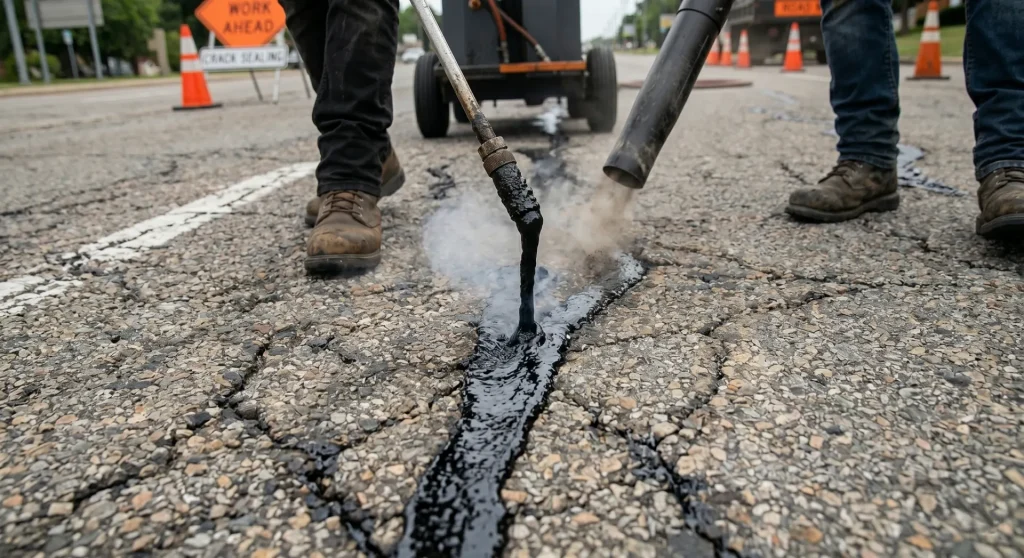
Repair Approach: Minor edge cracks can be effectively addressed by filling with rubberised sealants, which prevent moisture infiltration. However, crack sealing alone proves inadequate if the underlying support deficiency persists.
Extensive edge deterioration requires a systematic approach: remove vegetation within 1 metre of the edge, correct drainage issues, saw-cut to sound pavement, remove damaged sections, stabilise and compact the base course or shoulder material, and reconstruct the edge with proper compaction. Edge confinement (concrete kerbs, steel edging, or compacted shoulders) prevents recurrence.
Prevention: Design adequate shoulder width and material during initial construction and specify appropriate edge details for the expected traffic patterns. For car parks, concrete kerb and gutter systems provide permanent edge support. Maintain vegetation setbacks and ensure positive drainage away from pavement edges.
Protect Your Investment with Professional Asphalt Maintenance
Proactive identification and timely intervention distinguish cost-effective pavement management from expensive reactive replacement. The five distress types outlined above represent predictable failure modes that respond to systematic maintenance when addressed early.
Structural failures like crocodile cracking and potholes demand comprehensive solutions, whilst surface distress such as ravelling and minor edge deterioration remain manageable with appropriate surface treatments.
Kypreos Group provides comprehensive asphalt maintenance services throughout Sydney, helping developers and facility managers extend pavement life and reduce the total cost of ownership. Our team conducts structural assessments, recommends intervention timing, and executes repairs using materials that meet Transport for NSW specifications.
Contact us for a site assessment and maintenance strategy tailored to your facility’s traffic patterns and performance requirements.
Talk to the Kypreos Group team about asphalt paving, spray seal, road profiling and asphalt testing across Greater Sydney.


