
On this page
When specifying asphalt for a new warehouse development or distribution centre, understanding the distinction between commercial and industrial-grade pavement is critical. Incorrect specifications can lead to premature failure, costly repairs, and operational disruptions that negatively impact your bottom line.
While the terms are sometimes used interchangeably, commercial and industrial asphalt applications have fundamentally different engineering requirements. The difference is structural rather than just cosmetic, and it has significant implications for project budgets, longevity, and performance.
Key Insights
Commercial asphalt is designed for retail centres, office car parks, and public-access properties where traffic is frequent but predominantly light vehicles. Industrial asphalt is engineered for warehouses, distribution centres, and manufacturing facilities where heavy machinery and loaded trucks operate continuously.
The key differences:
- Thickness: Commercial typically uses 75-100mm; industrial requires 100-150mm+
- Traffic loads: Commercial handles passenger vehicles and light trucks; industrial must withstand forklifts, B-doubles, and static heavy loads
- Mix design: Industrial uses dense-graded asphalt with modified binders for superior durability
- Cost: Industrial asphalt costs 40-60% more upfront but delivers significantly better lifecycle value under heavy use
The Core Difference: Understanding Application Requirements
The distinction between commercial and industrial asphalt isn’t determined by project size or budget but by load capacity and usage patterns.
Commercial applications serve public-facing facilities. Shopping centre car parks, office building access roads, and retail driveways experience frequent but predictable traffic: passenger vehicles, occasional delivery vans, and light service trucks. The pavement must maintain aesthetic appeal and handle daily wear, but the imposed loads remain within manageable parameters.
Industrial applications support heavy operational requirements. Warehouses across industrial precincts, container terminals, and manufacturing plants face substantially different demands. Fully loaded semi-trailers weighing 42.5 tonnes manoeuvre through loading bays at walking pace. Forklifts traverse the same pathways hundreds of times daily. Heavy machinery remains stationary in designated zones for extended periods.
The engineering reality: a single loaded B-double exerts pavement stress equivalent to approximately 10,000 passenger vehicles. An incorrect specification results in rutting and structural deformation within months rather than the expected service life of decades.
Thickness and Structural Design Requirements
Commercial asphalt installations typically follow a standard specification: 75-100mm of hot mix asphalt over a properly compacted aggregate base. This configuration performs adequately for car parks at major retail centres or corporate office complexes where the heaviest regular vehicle is a standard delivery truck. (Here, it is also important to understand the hot vs cold mix differences).
Industrial sites require substantially greater structural depth. Distribution centres and warehouses commonly specify 100-150mm of asphalt, typically placed in multiple lifts. The initial lift provides primary structural capacity, while subsequent layers handle surface loads and prevent moisture infiltration into the pavement structure.
However, surface thickness alone doesn’t ensure adequate performance. The subbase underlying industrial asphalt must be engineered to handle concentrated point loads from forklift operations and sustained static loads from parked semi-trailers. Where commercial applications might utilise a 150mm crushed rock base, industrial facilities often require 300mm or more of carefully graded and compacted base material.
Australian road authorities provide specific guidance through AUSTROADS standards, which Sydney contractors must follow for compliant construction. For heavy industrial facilities, pavement design must specifically account for slow-moving traffic and vehicles that repeatedly stop and start in identical locations, creating concentrated stress points.
Mix Design and Material Specifications
Commercial asphalt employs standard dense-graded mixes optimised for cost-effectiveness and reliable performance. These mixes are formulated to provide adequate sealing properties, efficient water drainage, and a smooth, professional appearance. Asphalt paving services for commercial projects typically specify conventional binder grades appropriate for Sydney’s climatic conditions.
Industrial asphalt requires purpose-designed mix specifications. Aggregates are typically harder and more angular, such as crushed granite or basalt, rather than recycled materials. Binder content is precisely controlled, and polymer-modified binders are frequently specified for sites experiencing extreme loading conditions.
Dense-graded Superpave mixes represent the standard for industrial applications due to their superior resistance to deformation under heavy, slow-moving loads. These mixes utilise larger maximum aggregate sizes (typically up to 25mm) compared to commercial applications (generally 10-14mm). The larger stone particles create a more robust stone-to-stone contact structure that effectively resists rutting and permanent deformation.
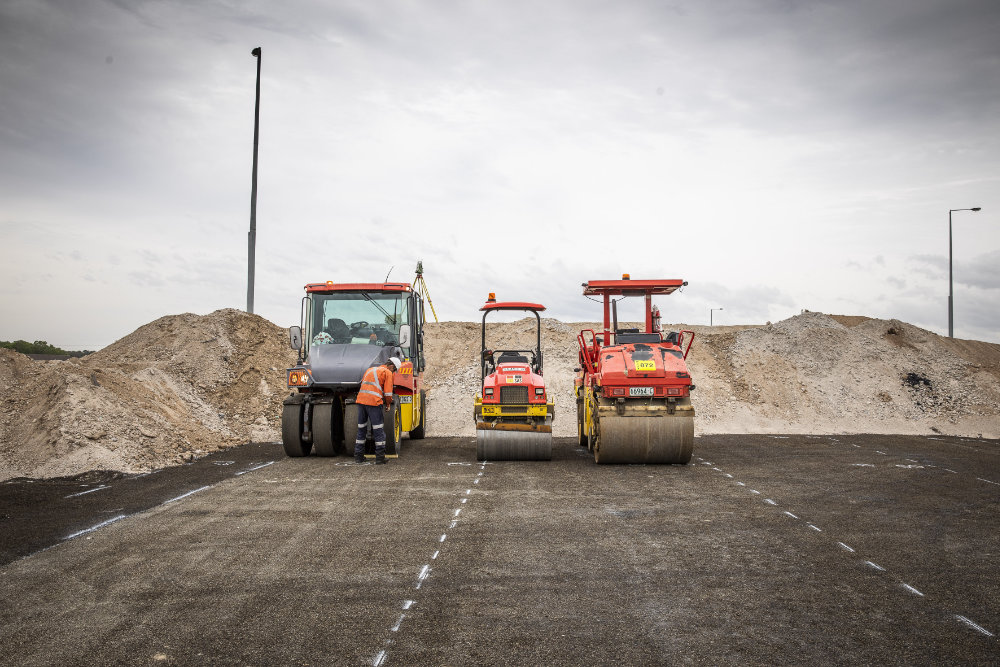
Quality assurance assumes greater importance in industrial projects. Asphalt material testing laboratories verify that mix designs meet stringent specifications for density, air void content, and Marshall stability – particularly critical when pavements will support heavy plant traffic and equipment.
Traffic Loading: Engineering for Actual Conditions
Commercial sites accommodate what pavement engineers classify as “light to moderate” traffic. A high-volume shopping centre car park might process 5,000 vehicle movements daily, with the vast majority being passenger cars and SUVs. Traffic loading is distributed relatively evenly across the pavement surface.
Industrial sites experience concentrated, repetitive heavy loading with distinct usage patterns. A single warehouse operation might handle 200 truck movements daily, each vehicle weighing 20-40 tonnes when fully loaded. More significantly, identical travel paths are used repeatedly, creating concentrated wear patterns in specific zones.
Drainage and Surface Infrastructure
Both commercial and industrial installations require adequate drainage systems, but the scale and complexity differ substantially.
Commercial car parks employ relatively straightforward drainage design, characterised by adequate surface fall (typically 1.5-2%) combined with strategically positioned drainage pits. Surface water disperses relatively quickly, and temporary localised ponding represents an inconvenience rather than a safety hazard.
Industrial sites demand robust, engineered drainage infrastructure. Large paved areas generate substantial runoff volumes. Heavy vehicles cannot safely navigate standing water, and moisture infiltration accelerates pavement deterioration. Distribution centres typically incorporate multiple catch basins, trench drains positioned along loading dock approaches, and precise grading to eliminate water accumulation in primary travel lanes.
Specification Guidelines: Commercial vs Industrial
Specify commercial-grade asphalt when:
- Maximum regular vehicle weight remains below 8 tonnes
- Primary site users are passenger vehicles and light commercial vans
- Access patterns are occasional or well-distributed across the pavement area
- The project serves retail, office, or light commercial functions
Specify industrial-grade asphalt when:
- Regular truck traffic includes vehicles exceeding 10 tonnes gross weight
- Forklifts or heavy mobile equipment will operate on the surface
- Loading bays or designated heavy vehicle parking areas are planned
- The facility functions as a warehouse, manufacturing plant, distribution centre, or similar operation
A transitional category exists: some commercial developments with regular heavy delivery access benefit from hybrid specifications. A retail centre with a dedicated service road for deliveries might appropriately specify industrial-grade asphalt in the service area while utilising commercial-grade pavement in customer parking zones.
Project Economics and Lifecycle Costing
Industrial asphalt specifications typically result in higher initial costs, ranging from 40% to 60% above those of commercial-grade installations for equivalent areas.
However, lifecycle economic analysis presents a different picture. Commercial asphalt might achieve a 15-20 year service life with appropriate maintenance. Industrial asphalt in high-stress applications can deliver 20-30 years or more of service precisely because it’s engineered to handle the actual imposed loads.
Advances in sustainable road materials and new asphalt technologies are improving project economics. Recycled materials can now meet industrial performance specifications, and warm-mix asphalt production reduces costs while maintaining structural performance, making industrial-grade asphalt increasingly cost-competitive for projects across Sydney.
Making the Right Specification Decision
The distinction between commercial and industrial asphalt reflects fundamental engineering principles governing load capacity, traffic patterns, and expected service life. For developers and construction firms, success depends on accurately matching pavement design to actual site conditions and operational requirements.
Proper specification requires understanding your project’s specific traffic loads, soil conditions, and operational patterns. Kypreos Group has extensive experience engineering pavements for applications ranging from retail centres to heavy industrial facilities across the Sydney metropolitan area. We can assess your requirements and recommend appropriate specifications that deliver long-term performance without unnecessary over-engineering.
Talk to the Kypreos Group team about asphalt paving, spray seal, road profiling and asphalt testing across Greater Sydney.


