
On this page
Sydney’s stormwater management requirements are becoming increasingly complex. Between Sydney Water’s regulations, council OSD (on-site stormwater detention) requirements, and the City’s Development Control Plan targets, pavement selection now significantly impacts project approvals, costs, and compliance outcomes.
The regulatory environment has tightened considerably, particularly in growth areas like Western Sydney. With stricter waterway health targets in the Aerotropolis precincts and enhanced water-sensitive urban design requirements, developers must understand how pavement choices impact both upfront costs and long-term project viability.
This article examines the technical and financial considerations for permeable pavement systems versus traditional asphalt in commercial developments.
Key Insights
- Initial costs: Traditional asphalt costs $30-40/m²; permeable pavers cost $180-190/m²
- Life cycle economics: Permeable systems can be more cost-effective over 20-30 years when stormwater infrastructure costs are included
- Regulatory advantages: Permeable solutions may reduce OSD requirements, potentially accelerating approvals
- Service life: Permeable pavers last 20-30+ years compared to 15-20 years for traditional asphalt
- Best applications: Large developments, sites with drainage constraints, projects near waterways, or where space for detention basins is limited
Understanding the Total Cost Picture
Initial capital costs clearly favour traditional asphalt paving. However, whole-of-life costing reveals important differences developers should consider.
Whole-of-life cost modelling consistently shows that when stormwater infrastructure is included in the comparison, permeable systems can match or undercut the total cost of asphalt over a 20–30 year period. Australia’s water-sensitive urban design frameworks, including guidance from Melbourne Water and the Greater Adelaide WSUD Technical Manual, recognise this calculus explicitly — factoring in the cost of detention basins, underground storage and treatment infrastructure that permeable surfaces can reduce or eliminate.
The larger cost factor for Sydney developments is stormwater infrastructure. Impermeable surfaces typically require on-site detention systems, underground storage tanks, or contributions to regional stormwater schemes. These add significant capital costs. Permeable pavements manage stormwater at source, potentially reducing or eliminating these requirements and freeing up land that would otherwise be dedicated to detention infrastructure.
Sydney’s Stormwater Compliance Requirements
Sydney Water and local councils have implemented comprehensive stormwater management protocols. Developments in the City of Sydney area must meet specific water quality targets under the Sydney Development Control Plan 2012. In Western Sydney’s Aerotropolis precincts, enhanced waterway health targets apply to the Wianamatta-South Creek catchment, with current bonding rates set at $1.019 million per developable hectare.
Permeable pavement qualifies as an integrated stormwater management solution within this framework. Because it infiltrates water on-site and provides natural filtration through aggregate layers, it can help satisfy compliance requirements without separate treatment infrastructure. For qualifying projects, this can mean faster approvals and reduced bonding requirements.
Technical Performance: How Each System Works
Traditional Asphalt
Conventional asphalt construction remains the standard choice for high-traffic applications. It offers proven performance, competitive upfront costs, and widespread contractor expertise – particularly important when working with experienced commercial asphalt contractors.
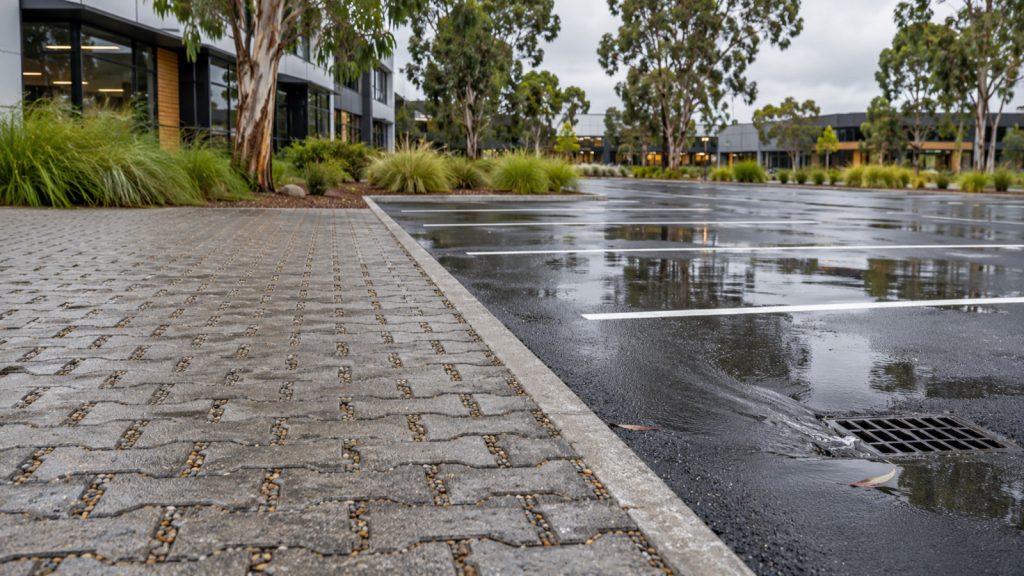
The benefits of asphalt include that it’s completely impermeable, meaning all rainfall becomes surface runoff. This water carries oils, heavy metals, and sediments directly into stormwater drains. In Sydney’s regulatory environment, developers must manage and treat this water through separate infrastructure.
Design life is typically 15-20 years, provided there is appropriate maintenance. Performance in high-traffic areas and under heavy vehicle loads is well-established. The material also effectively handles Sydney’s temperature variations.
Permeable Interlocking Concrete Pavers
Permeable interlocking concrete paver (PICP) systems feature wider joints filled with small aggregate. Water drains through these joints into an engineered crushed stone reservoir below, where natural filtration occurs before infiltrating into the soil or being discharged in a controlled manner.
The system offers several advantages for commercial developments: reduced peak stormwater flows, groundwater recharge, and natural pollutant filtration. The concrete pavers themselves are highly durable, often outlasting traditional asphalt by 5-10 years.
Maintenance involves vacuum sweeping 3-4 times annually to prevent joint clogging. No resurfacing, resealing, or extensive patching is required. Individual damaged pavers can be replaced without reconstructing entire sections.
The main considerations are installation complexity (requiring contractors experienced with layered base systems) and higher initial costs that need to be evaluated over the asset’s full life cycle.
When to Specify Each Option
Permeable pavers are well-suited for projects where:
- Site drainage is challenging or clay soils require careful stormwater management
- Development is near sensitive waterways (harbour, creek corridors, wetland buffers)
- Site space is constrained and cannot easily accommodate detention basins
- The project includes large car park areas where regular vacuum sweeping is already planned
- Sustainable construction credentials or green building certifications are project objectives
- Long-term ownership allows the developer to benefit from lower maintenance costs
Traditional asphalt is appropriate for:
- High-speed roads or heavy industrial areas
- Projects where initial capital costs are the primary consideration
- Developments with adequate space for conventional stormwater infrastructure
- Fast-track programmes requiring familiar installation methods and short timeframes
Installation and Programme Considerations
Installation complexity is an important factor in project planning.
Most civil contractors can install asphalt efficiently, as the process is straightforward and well understood. Permeable systems require precise sub-base preparation, correctly graded aggregate in multiple layers, and accurate paver installation to ensure joints align properly for drainage. This demands contractors with specific PICP experience.
This is particularly relevant in Sydney, where project timelines are tight and weather-dependent civil works have limited windows. Permeable installations typically take longer, though eliminating separate detention system construction may offset this on the overall programme.
A Practical Approach
Most Sydney commercial developments benefit from a hybrid pavement strategy.
Specify traditional asphalt for main access roads, loading zones, and high-traffic areas where proven durability under demanding conditions is essential. Use permeable pavers in car parks, overflow areas, and lower-traffic zones, where they effectively manage stormwater while reducing overall infrastructure costs.
This approach balances cost efficiency with regulatory compliance while managing technical risks appropriately.
Need technical guidance for your Sydney development project? Kypreos specialises in asphalt paving services for commercial and residential developments across Sydney. We can assess your site’s stormwater requirements and recommend cost-effective pavement solutions that meet Sydney’s compliance standards. Contact us for a site-specific assessment and detailed cost analysis for your project.
Talk to the Kypreos Group team about asphalt paving, spray seal, road profiling and asphalt testing across Greater Sydney.


